Jumat, 13 September 2013

Adversaries No More: The Carabinieri and MFA Enjoy Cultural Exchange Partnership

News stories from 1998 once chronicled the acquisition of looted archaeological material by Boston's Museum of Fine Arts (MFA). And the Boston Globe critically reported in 2006 that the MFA "has long contended it did not know of any stolen objects in its collection."

Col. Luigi Cortellessa speaks with an audience member at
the Museum of Fine Arts, Boston.
That is why Luigi Cortellessa's presence Thursday night at the MFA is so remarkable. He serves as Colonel in Italy's Carabinieri Division for the Protection of Cultural Heritage (TPC).

Cortellessa praised the cultural exchange partnership now enjoyed between his country and the MFA, and presented photos in the museum's lecture hall of looted objects repatriated to Italy that were previously in the MFA's collection.

To demonstrate the importance of the TPC's mission to protect cultural heritage from theft and plunder, Cortellessa showed slides poignantly illustrating the catastrophic destruction of archaeological sites in Italy, including heavy damage caused by looters using a construction excavator.

Between 1970 and 2012 the Carabinieri recovered 1,058,499 archaeological artifacts from all sources and secured 30,621 criminal indictments, Cortellessa explained to an engaged audience.

Cortellessa's appearance in Boston, along with Consul General Giuseppe Pastorelli and other Italian government officials, signals the changed direction the MFA has traveled in recent years to resist the accession of contraband antiquities. It is a path that contrasts with other major institutions that continue to acquire questionable archaeological artifacts even when conceding that they are "unable to obtain documentary confirmation of portions of the provenance."

This post is researched, written, and published on the blog Cultural Heritage Lawyer Rick St. Hilaire at culturalheritagelawyer.blogspot.com. Text copyrighted 2010-2013 by Ricardo A. St. Hilaire, Attorney & Counselor at Law, PLLC. Any unauthorized reproduction or retransmission of this post is prohibited. CONTACT INFORMATION: www.culturalheritagelawyer.com

Kamis, 12 September 2013

U.S. v. Cambodian Sculpture Case Heats Up: Prosecutors Accuse Sotheby's of Stalling the Discovery Process and False Information; Sotheby's Accuses the Government of Burdensome Conduct and Invented Legal Theories

A letter filed by prosecutors before today's scheduled pre-trial conference in the case of United States of America v. A 10th Century Cambodian Sandstone Sculpture Currently Located at Sotheby's criticizes Sotheby's for trying to halt the discovery process. Lawyers for the U.S. Attorney's office in Manhattan submitted the letter to the court on Wednesday. It restates more forcefully arguments made in May, saying
Both before and after this action, Claimants have sought at every turn to prevent the Government from unearthing the facts about the theft and sale of the Duryodhana. At every stage of this proceeding they have invented a new reason why going forward with discovery would be inappropriate. Discovery has already been halted for nearly a year while they fought first the motion to dismiss, and then their request for a hearing on the Cambodian law. Now they seek to stay discovery yet again. The Court should not permit them to do so.
Meanwhile, Sotheby's and Decia Ruspoli di Poggio Suasa, the claimants in the government's forfeiture case, filed a Motion for Judgment in federal district court on September 9. They argue that the Cambodian government did not believe that its national ownership laws gave it ownership to the sculpture; that the U.S. State Department "had invented a theory of Cambodian ownership, which the government then asked Cambodia to confirm;" that the government interfered with a potential resolution to the case; and that the government's request for discovery is "broad and burdensome."

In the claimants' memorandum of law, Sotheby's introduces Professor Alexandre Deroche to the court, saying that "he provides the expert evidence the Court sought, and it establishes that the Government’s case is wrong. Professor Deroche is an expert in the very area of law on which the Government based its case: French colonial property law in Indochina."

Sotheby's sharply criticizes the government for its latest attempt to push for discovery, saying "The Government served deposition notices on Wednesday, September 4, 2013. Several of the noticed witnesses are overseas. Three are members of Sotheby's legal and compliance departments, presumably in an effort to discover whether Sotheby's somehow intuited a theory of Cambodian ownership based on defunct French colonial decrees, even though the newly produced documents show the theory was invented by the State Department and was previously unknown even to the Cambodian government itself."

Federal prosecutors dispute the claimants' arguments.

"As for the notion that the Government was the obstacle to an amicable resolution here, the Government deferred bringing any action in this matter for more than a year after learning of Sotheby's attempted sale of stolen property to allow Cambodia and Claimants to attempt to resolve the matter without litigation," the prosecutors counter. "That attempt failed not due to the Government’s intervention, but because Claimants rejected the offer of a third party to buy the Duryodhana for $1 million and return it to Cambodia."

Arguing against a halt of the discovery process, the federal lawyers rail against Sotheby's conduct. They explain that the auction house Spink and Sons sold the Duryodhana in 1975, and that a Homeland Security Investigations (HSI) agent was informed that Christie's--owner of Spink after 1975--currently had the records. But the prosecutors contend that Sotheby's "discouraged [the HSI agent] from contacting Christie's, assuring [the HSI agent] that Sotheby’s had 'identified two individuals who presently have no financial interest in the property and who personally saw the piece in London in the late 1960s.'" The prosecutors claim that this information "was simply false." They explain, "As shown by the Spink records ultimately obtained by the Government from Christie's, the Duryodhana was only stolen from Prasat Chen in 1972. Moreover, the sources with no financial interest 'presently' were in fact the original seller of the piece, who conspired with the looting network to steal it from Prasat Chen (the “Collector”), and Sotheby’s own retained art expert, who was herself was a longtime associate of the Collector."

Update September 13, 2013: Sotheby's submitted a letter to the court stating, "Any suggestion that Sotheby's provided information it knew to be inaccurate is demonstrably not true."

U.S. authorities seek forfeiture of the Duryodhana sculpture in order to repatriate it to Cambodia. They allege that the cultural object is from the Prasat Chen temple at Koh Ker and that it's feet remain in Cambodia. The U.S. government says that it cannot be auctioned by Sotheby's because it stolen property.

This post is researched, written, and published on the blog Cultural Heritage Lawyer Rick St. Hilaire at culturalheritagelawyer.blogspot.com. Text copyrighted 2010-2013 by Ricardo A. St. Hilaire, Attorney & Counselor at Law, PLLC. Any unauthorized reproduction or retransmission of this post is prohibited. CONTACT INFORMATION: www.culturalheritagelawyer.com

Rabu, 11 September 2013

Seize and Send: No Arrests Announced as ICE Sends Evidence Back to Afghanistan

Roman oinochoe. Courtesy of ICE.
U.S. Immigration and Customs Enforcement (ICE) this week sent back evidence of cultural heritage trafficking to Afghanistan without making any arrests. The items returned include an ancient Roman oinochoe (right), 5th century B.C. gold foil appliques, and 17th century gold ornaments.

U.S. Customs and Border Protection (CBP) and the Homeland Security Investigations (HSI) New York El Dorado Task Force seized the objects at Newark Liberty International Airport's cargo facility on March 21, 2011, says ICE. An ICE news release reports that "HSI New York special agents discovered they were destined for a New York City man and later to a New York business suspected of dealing in looted cultural property. Through the investigative process, the antiquities were found to have originated in Afghanistan."

Customs administratively forfeited the items on Jan. 25, 2012. It may be reasonable to infer that those responsible for the illegal trafficking operate in the U.S., Great Britain, and the Middle East judging from ICE's announcement that "HSI New York, London and Dubai are conducting this ongoing investigation."

HSI Assistant Director John Connolly is quoted as saying, "Today marks HSI’s fourth cultural repatriation to Afghanistan since 2005. We are committed to the continued cooperation between our countries and beating back this illicit trade through dedicated law enforcement efforts, partnerships and training thus preserving and protecting the world’s ancient and valued treasures." Connolly's prepared remarks make no mention of either arrests or indictments.

The pattern of ICE returning evidence of cultural heritage trafficking without prosecution is common. There is an apparent policy of "seize and send" promoted by ICE leadership whereby the agency seizes illegally stolen or smuggled cultural objects and sends them back to their country of origin. This policy has been criticized before because it overemphasizes the recovery and repatriation of cultural heritage objects at the expense of investigating and indicting smugglers, fences, and receivers of stolen property who knowingly contribute to the destruction of cultural heritage. It is expected that fraud, money laundering, and other felony crimes too escape criminal prosecution as traffickers convert illegally obtained antiquities into cash.

While ICE's financial crimes investigations yield numerous arrests and prosecutions, ICE's cultural property, art, and antiquities investigations do not regularly result in criminal prosecutions.

HSI claims that its investigation surrounding the Afghani objects returned this week is "ongoing." But what direction the investigation is going in remains unclear. Will criminal indictments be pursued? Or will ICE's latest repatriation of cultural artifacts serve as a further reminder that the agency's leadership will seize cultural contraband but not arrest the criminals who unlawfully steal, smuggle, transport, sell, or buy them?

This post is researched, written, and published on the blog Cultural Heritage Lawyer Rick St. Hilaire at culturalheritagelawyer.blogspot.com. Text copyrighted 2010-2013 by Ricardo A. St. Hilaire, Attorney & Counselor at Law, PLLC. Any unauthorized reproduction or retransmission of this post is prohibited. CONTACT INFORMATION: www.culturalheritagelawyer.com

Minggu, 08 September 2013

Upcoming MFA Lecture: "The Role of the Carabinieri in Combating Art Theft in Italy"

"The Role of the Carabinieri in Combating Art Theft in Italy" is the title of this week's lecture at the Museum of Fine Arts, Boston. Colonel Luigi Cortellessa of the Carabinieri Division for the Protection of Cultural Heritage will be the featured speaker.

The event will be held at the MFA at 6:30 p.m. on Thursday, September 12.  For complimentary museum admission, email hstockton@mfa.org.

The lecture is held in conjunction with the 2013 Year of Italian Culture, featuring the MFA's exhibition of Piero della Francesca’s Senigallia Madonna, one of three stolen paintings recovered in 1975 by Italy’s Carabinieri.

This post is researched, written, and published on the blog Cultural Heritage Lawyer Rick St. Hilaire at culturalheritagelawyer.blogspot.com. Text copyrighted 2010-2013 by Ricardo A. St. Hilaire, Attorney & Counselor at Law, PLLC. Any unauthorized reproduction or retransmission of this post is prohibited. CONTACT INFORMATION: www.culturalheritagelawyer.com

Uni and Work. Is it the same thing? Part 1 of tips for your transition

You've finished uni and you're about to start as a Graduate/Trainee Solicitor. Think it's the same thing? Late nights, lots of reading and trying to impress your superiors while (secretly) trying to outdo your fellow junior colleagues. Wrong.

Working life is completely differently. Yes you still need the same drive and ambition, but your first lesson will be learning the environment and atmosphere.  It's like Dr Lois Frankel says - you need to learn the office politics in order to get ahead. 

Just don't watch Suits the night before your first day. You are not Mike Ross, you're the Harold. You won't have a Rachael and the Jessica won't know your name. Your supervising Partner will be a Harvey, but you won't be getting home visits or spoon fed on cases. 

Here's a few of my tips (this was about 3 times as long but I've cut it back - will do a part 2 soon!) on what I have learned through the past 6 years. 

1. Identify opportunities

Your job is to make sure the Senior Associates/Special Counsel/Partners have the correct information they need to give advice to the client. If you come up with two answers, or two paths, go to whoever gave you the task and say "I think we could go this way or this way, but it depends on this". Don't just give them both in a memo and leave it. Use your initiative. 

You nail the research, the Partner nails their advice. I will never forget the first "great work" on a memo I had given a Partner. I had worked hard on this research and it was good it was recognised. Just don't expect this constantly. Partners aren't there to blow smoke up your butt - but they will acknowledge hard work when it's earned. 

2. Ask Questions - but don't suck up

Personally I love questions. The best is "why are you doing it that way". If you've helped me with a task and the advice/documents have gone, follow it up. Ask for a copy or 5 mins to discuss why that path was chosen. This is how you learn. 

But don't ask questions if you know the answer, or you just want to show off. Partners don't have time for that. I was instructing at my first criminal trial and the Barrister I was instructing said to me "I don't ask a witness a question unless I know the answer and don't ask me a question if you can't anticipate my answer". Best piece of advice ever. 

3. That's not my job, ahh well it is

You're a Grad. Everything is your job. Look at the positives a) you're being asked and b) think about what you will learn. 

Every task has a purpose. Photocopying a brief isn't just numbering pages. It's your opportunity to see how a litigation runs. Use it to your advantage and familiarise yourself with the documents and why they are in there. 

You cant keep your "I'm a law student" attitude. That will need to change quick smart. Being a graduate is similar to going from Grade 7 to Grade 8. One minute you're at the top, next you're at the bottom. Deal with it and get back to the top again. 

4. Don't stay long hours if you don't have work to do
There are so many opinions on this. Some stay stay longer than everyone else, others say only stay if you're needed. 
 
I say there is a middle ground. If you're meant to be there 8.30am to 5pm, be prepared to be there 8am to 530pm. Let your supervisors know if have capacity and pop your head in before you leave. Work in with your partner, if they are early risers, maybe try getting in early if you need to see them. Just remember work life balance (see past post). 
Your biggest asset will be your ability to judge your workload. There's a difference between staying back and getting a task done so you can say its done and staying back due to an urgent timeframe. I could be in the office 24 hours a day if I didn't know the difference. Prioritise. Your work will never be done. There's always something waiting for you. 
5. Create a precedent list
 
This will be your greatest asset. Mine has a contents page and is broken down into categories and sub-headings. Nerd I know. 
 
But case law is so important and as a Grad you will have first hand access which will help you for the rest of your career. 
~~~
Moving forward (get used to that saying) - you will get there. You just need to prove yourself. My philosophy is work hard while you are a junior and prove your worth. Don't step on toes or over toes. Make sure your bring up list is checked daily and do a completely file review monthly. 
 
Don't think you're too good for any task. Don't backchat and don't get it wrong. Try your hardest. Being a lawyer is all about reputation. Your Graduate years will define you. 
 
To my fellow career girls, do yourself a favour and read Nice Girls Don't get the Corner Office by Dr Lois Frankel. It will help you with your behaviour and attitude and leads me to my next blog post - your professional voice vs your personal voice. Massive thanks to Katherine Feeney, Brisbane Times who gave me the idea for my next post. 

Selasa, 03 September 2013

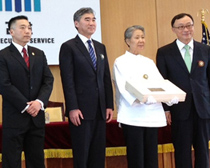
Korean Currency Plate Returned

Currency plate repatriation ceremony. Source: ICE
U.S. Immigration and Customs Enforcement (ICE) today returned the Hojo currency plate seized as evidence in the criminal prosecutions against Wong Young Youn and James Amato. Prosecutors dismissed the pairs' cases earlier this year.

ICE today clarified in a public statement, "To avoid criminal prosecutions, both men entered into agreements with the government forfeiting their claims to the currency plate." The agency added, "Youn, a Korean native who was illegally present in the United States, agreed to voluntarily depart the country and returned to his native country July 31. Amato entered into an agreement for pretrial diversion and has satisfactorily met the following conditions: 90-days of supervised release; payment of $35,000; and 40 hours of community service."

U.S. Ambassador Sung Y. Kim transferred the currency plate during a ceremony held in Seoul, pictured above.


This post is researched, written, and published on the blog Cultural Heritage Lawyer Rick St. Hilaire at culturalheritagelawyer.blogspot.com. Text copyrighted 2010-2013 by Ricardo A. St. Hilaire, Attorney & Counselor at Law, PLLC. Any unauthorized reproduction or retransmission of this post is prohibited. CONTACT INFORMATION: www.culturalheritagelawyer.com

Senin, 26 Agustus 2013

Chicago Museums Seek Summary Judgment in Rubin v. Iran

The Field Museum of Natural History and the University of Chicago's Oriental Institute filed a motion for summary judgment last week seeking to end a case that has pitted victims of a terrorist attack against two Illinois museums and Iran. The Chicago-based institutions argue that the plaintiffs' wish to take museum "property that Iran neither owns nor has ever claimed." And regarding Persian artifacts owned by Iran but on loan to the museums, the museums say that the plaintiffs cannot take title to these objects in order to satisfy a court judgment. American lawyers representing Iran filed their own motion in agreement.

The museums offer three arguments in their legal memorandum to defend the ancient Persian collections known as the Persepolis Collection, the Chogha Mish Collection, the Herzfeld Collection, and the OI Collection. The lawyers write,
First, even if Plaintiffs could meet their burden to establish Iranian ownership of the collections at issue, those artifacts would irrefutably be immune from attachment under the Foreign Sovereign Immunities Act [FSIA]. To avoid that immunity, the law requires that Plaintiffs prove that Iran itself used these artifacts commercially. Plaintiffs have no such evidence.
The FSIA is a federal law that protects foreign states from lawsuits and makes foreign sovereign property located in the United States immune from attachment and execution. But the law makes an exception, stating that “[a] foreign state shall not be immune from the jurisdiction of courts … in which rights in property taken in violation of international law are in issue and that property … is present in the United States in connection with a commercial activity carried on in the United States by the foreign state … [or an] instrumentality of the foreign state ….”  (italics added). The museums argue that the Persian artifacts were not part of any Iranian commercial activity.

Second, the museums assert that the Terrorism Risk and Insurance Act (TRIA) cannot be used to take the artifacts. And another court, in fact, has already ruled on this issue, barring any reargument in Illinois. The attorneys write,
...Plaintiffs invoke the Terrorism Risk and Insurance Act (“TRIA”), which allows seizure of a terrorist party’s “blocked” assets. But the First Circuit recently rejected this very same argument made by these very same Plaintiffs in attachment proceedings against two Boston-area museums. Rubin v. Islamic Republic of Iran, 709 F.3d 49, 57-58 (1st Cir. 2013). That ruling is not only correct, it is also binding on Plaintiffs as a matter of collateral estoppel. The requisite “contest” under TRIA may not be created by judgment creditors purporting to stand in a foreign sovereign’s shoes.
Finally, the museums object to the plaintiffs' claim that they can attach the museums' property because Iran--and not the museums--own the artifacts. "The only basis for this claim is Plaintiffs’ speculation that the objects in the Museum Collections may have been unlawfully removed from Iran after 1930 and subsequently conveyed to the Field  Museum or the Oriental Institute," the lawyers say, adding "But Iran has never made a claim to the Museums’ property and, despite eight years of discovery, Plaintiffs have failed to adduce any evidence that Iran owns a single object in the Museum Collections." The Attorneys contend,
...although the Court need not reach the issue given the legal barriers that the FSIA and TRIA erect to Plaintiffs’ claims, these artifacts are owned by the Museums. Plaintiffs’ theory of Iranian ownership depends on an interpretation of a 1930 Iranian export law that is without merit. Indeed, several courts have rejected Plaintiffs’ theory and none, so far as we are aware, has accepted it. Moreover, the statute of limitations and the good faith purchaser rule are additional barriers to any claim of Iranian ownership. Ultimately, Plaintiffs simply cannot meet their legal burden to establish that the Museums hold property that is subject to attachment, or indeed, that belongs to Iran at all. Summary judgment should be entered in favor of the Museums...."
Iran similarly makes three arguments, based on the FSIA and TRIA statutes. The lawyers write in their legal memorandum,
The Fortification Texts [of the Persepolis Collection] and Chogha Mish objects are property of a foreign sovereign and therefore immune from attachment and execution. The FSIA’s commercial activities exception, 28 U.S.C. § 1610(a)(7), does not apply; Iran has never used the artifacts for a commercial purpose in the United States. While Plaintiffs urge that the Institute’s activities are attributable to Iran under an “agency” theory, it is implausible that the Institute is Iran’s “agent.” Iran merely lent the artifacts to the Institute for study, and Plaintiffs raise no material issue of fact for their agency theory. In any event, the Institute’s activities are academic, not commercial.
The lawyers further declare that "[t]he Fortification Texts and the Chogha Mish objects are not subject to execution under the TRIA ... because they are not 'blocked assets.'" By way of background, "blocked assets" are properties that have been seized or frozen by the U.S. government. The TRIA allows seizure of blocked assets to satisfy court judgments “in every case in which a person has obtained a judgment against a terrorist party on a claim based upon an act of terrorism, or for which a terrorist party is not immune under [the FSIA] ….” Iranian “blocked assets” as defined by the Iranian Assets Control Regulations are uncontested assets, meaning that there is no dispute about whether Iran holds title. With this in mind, lawyers for Iran submit in their legal memorandum that "[a]lthough Plaintiffs have urged that the artifacts are 'blocked' because their ownership is 'contested,' no contest exists. The Institute has never asserted title or ownership; it has always agreed that those artifacts belong to Iran. The United States agrees that the assets are not 'blocked.'"

Finally, Iran's attorneys offer the technical argument that the Rubin plaintiffs cannot use an exception under the FSIA law to acquire the artifacts, specifically § 1610(g). They write, "To the extent Plaintiffs assert that the Fortification Texts and the Chogha Mish objects are subject to attachment under § 1610(g) of the FSIA, they are mistaken. Plaintiffs cannot invoke § 1610(g) because they did not raise it before the Seventh Circuit."  The lawyers add,
That provision, moreover, at most subjects property of entities that are legally distinct from the sovereign (such as agencies and instrumentalities) to execution to satisfy a judgment against the sovereign—if that property otherwise lacks immunity because it falls within one of § 1610’s express exceptions. Consequently, §1610(g) is inapplicable. And § 1610(g) applies only to judgments entered under § 1605A. Plaintiffs’ judgment was entered under § 1605(a)(7), and retroactive conversion of Plaintiffs’ judgment would violate separation of powers.
The case of Jenny Rubin, et al. v. Islamic Republic of Iran v. The Oriental Institute et al. began in the Illinois federal district court in 2003 after Rubin and the other plaintiffs won a $71.5 million default court judgment against Iran for that country's role in supporting a 1997 terror attack launched by Hamas. To get Iran to satisfy its judgment, the plaintiffs sued the Field Museum and the Oriental Institute for the ancient Iranian artifacts.

The litigation traveled from the Northern District of Illinois to the Seventh Circuit Court of Appeals, and was later sent back to the district court. But the Rubin plaintiffs sought review along the way by the U.S. Supreme Court. The nation's high court returned the case to the district court last year after declining to hear the Rubin plaintiffs' request to critique the Seventh Circuit's appellate decision.

UPDATE: The plaintiffs in the litigation filed responses to the museums' motion for summary judgment in November and December 2013.

Photo credit: sumeja

This post is researched, written, and published on the blog Cultural Heritage Lawyer Rick St. Hilaire at culturalheritagelawyer.blogspot.com. Text copyrighted 2010-2013 by Ricardo A. St. Hilaire, Attorney & Counselor at Law, PLLC. Any unauthorized reproduction or retransmission of this post is prohibited. CONTACT INFORMATION: www.culturalheritagelawyer.com